

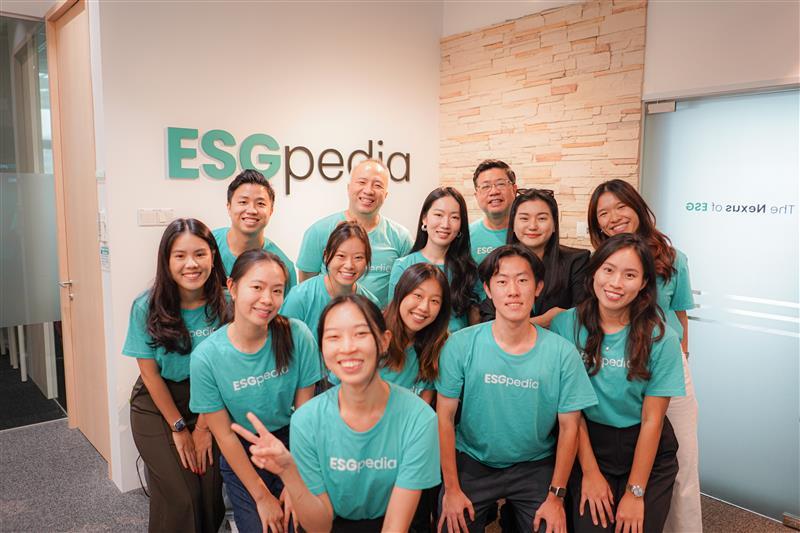
ESGpedia is an ESG data and technology company that helps organizations manage sustainability through digital tools, with work spanning carbon management, sustainability reporting, supply chains and ESG data. Here, sustainability is not simply a corporate ambition or a topic for reports. It becomes a set of practical questions that need to be measured, analyzed and translated into business decisions.
Through Taipei’s 2025 Youth Overseas Internship Program, Victor and Olivia joined ESGpedia in Singapore with very different backgrounds. Victor had focused on earth sciences, agricultural economics and climate-related issues, while Olivia brought experience in business development, sales management and data analysis. Their paths were different, but both faced the same question: how can the skills they already have create value in a fast-evolving sustainability industry?
From Expertise to Business Value
For Victor, one of the biggest shifts was learning how to bring scientific knowledge into the problems companies deal with every day.
His academic background had exposed him to topics such as carbon sequestration, wetland monitoring and climate policy. At ESGpedia, those interests became much more practical. He worked on greenhouse gas inventories, emissions classification and sustainability frameworks including the GHG Protocol, ISO 14064, GRI, DJSI and TNFD. Concepts that had previously belonged to courses, research and policy documents became tools that businesses needed to understand and apply.
The challenge was not simply calculating emissions. Companies also needed to know what those numbers meant: where the risks were, what should be addressed first, how to respond to supply-chain or investor expectations, and how technical information could support real decisions.
Victor began to see that his scientific background did not have to remain within academia or environmental research. With a better understanding of business, finance and markets, the same expertise could become part of solving commercial problems.
True interdisciplinary work is not simply knowing several fields. It is being able to help different fields understand one another.
That realization also gave him a clearer sense of direction. Rather than choosing between environmental expertise and business, he began to imagine a career connecting the two.
Olivia entered the sustainability sector from the opposite direction.
With previous experience in business development and sales management, she was already familiar with market expansion, customer engagement and the importance of data in decision-making. At ESGpedia, the question became how those strengths would translate into a new industry.
As part of the Business Development team, she contributed to opportunities in the Taiwan market and engaged with industry associations and sustainability-related organizations. She also encountered sustainability data and reporting across sectors including finance, construction, tourism and consumer goods, and saw first-hand that different industries face very different ESG priorities.
She also brought her own data and management experience into the team. Drawing on her understanding of sales operations, Olivia developed a sales dashboard to organize Business Development activity across Asia-Pacific and give the team a clearer view of market progress.
When your skills begin to solve real problems for a team, an internship stops being only about what you can learn. It also becomes about what you can contribute.
For Olivia, sustainability became more than a fast-growing industry trend. She saw it as a field with technology, customers, market demand and international competition, where the business skills she already had could take on new meaning.
Seeing Sustainability Through Singapore
Singapore added another layer to both experiences.
Within ESGpedia’s international team, Victor saw how technical arguments had to be supported by data and clear frameworks, and how complex information eventually had to become concise recommendations that clients could understand and use. Sustainability, in other words, was not only an academic or policy issue; it was a profession that required an understanding of technology, industry and business at the same time.
Olivia saw the market from another angle. Working across sustainability and business development made her more aware that the same ESG agenda can evolve differently depending on a country’s industrial structure. Taiwan’s deep role in global manufacturing supply chains means many companies have already had to respond to international sustainability requirements. Singapore, by contrast, showed her an ecosystem shaped strongly by finance, regional headquarters, international talent and multinational businesses.
That comparison gave the overseas experience a deeper purpose. It was not simply about identifying what another country does differently. It also helped both participants recognize what Taiwan already has to offer.
For Victor, Singapore’s emphasis on planning, efficiency and international connectivity raised new questions about how Taipei can continue responding to sustainability and globalization. For Olivia, the experience reinforced another idea: internationalization does not have to mean copying someone else’s model. Taiwan’s strengths in technology, manufacturing and global supply chains are themselves assets that can be brought into international conversations.
What the Exchange Created
On paper, Victor and Olivia’s internships can be summarized through technical terms: carbon accounting, sustainability reporting, ESG platforms, business development, data analysis and sustainable supply chains.
What stayed with them, however, was more than a longer list of skills.
Victor learned how environmental knowledge could be translated into information companies can act on. Olivia discovered that the business and data skills she already had could create value in a new international industry.
For ESGpedia, the two participants also brought different ways of approaching sustainability. One came from environmental science and policy; the other from business, markets and data. Bringing those perspectives into the same organization added more than extra capacity—it added different ways of understanding a problem.
That two-way value is central to Taipei’s Youth Overseas Internship Program. Young people enter international workplaces with skills they have already built, then test, extend and recombine those skills through real assignments. Host organizations, in turn, gain access to young talent from Taipei with different professional backgrounds, market knowledge and perspectives.
For Taipei, the long-term value is not simply the number of young people who have completed an internship abroad. Each participant returns with a more concrete understanding of industries, markets and professional practice, while also bringing the capabilities and perspectives of Taipei’s young talent into international teams.
They return with a clearer sense of what they can contribute—and what Taipei can bring to the world.