

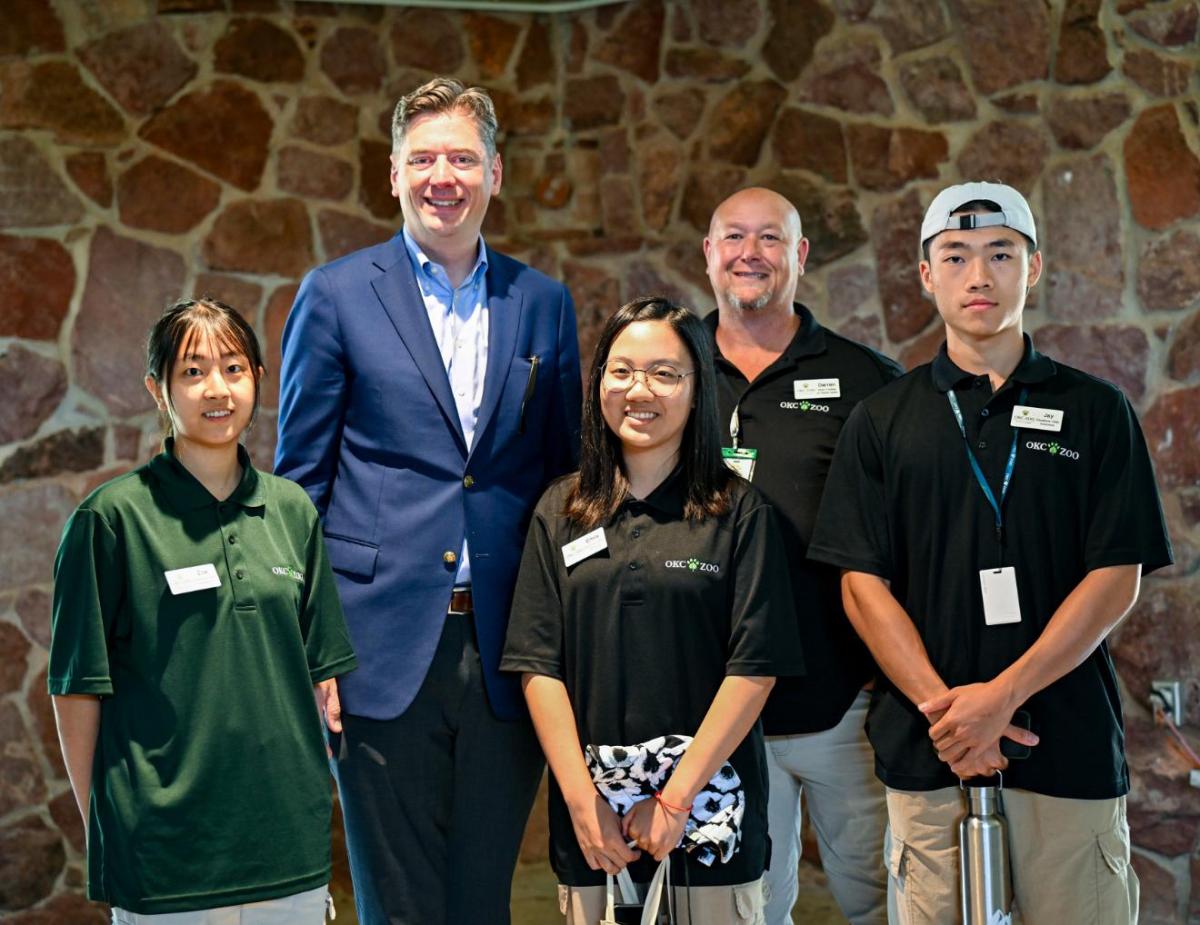
The Oklahoma City Zoo and Botanical Garden is more than a place to see wildlife. Alongside animal care, the Zoo brings together horticulture, conservation and environmental education, using its grounds and programs to help people build a stronger connection with wildlife and the natural world.
Oklahoma City also has a special connection with Taipei. The two cities have been sister cities since 1981, a relationship that has continued for more than four decades. Through Taipei’s 2025 Youth Overseas Internship Program, that connection reached a new generation when Zoe, Jay and Emily spent a month at the Zoo, learning alongside its horticulture team and gaining first-hand exposure to plant care, native species, conservation, animal welfare and the many professions that come together behind the scenes of a modern zoo.
What began as an overseas placement at a zoo soon became something broader: an opportunity to see how people, plants, animals and an entire institution are connected—and to return to Taipei seeing their own surroundings a little differently.
Beyond the Animals
For most visitors, animals are naturally the first thing they notice at a zoo. For Zoe, Jay and Emily, spending time with the horticulture team gradually drew their attention to something that usually remains in the background: the plants.
Across the Zoo, they followed horticulture staff through different areas and learned about pruning, watering, propagation, seed collection and the everyday care that goes into maintaining the landscape. They began to understand that the spaces visitors experience as natural and effortless are, in fact, shaped by constant attention and professional knowledge. Even something as ordinary as weed control takes on a different meaning when it must be managed carefully around animals and other plant life.
That lesson stayed with Jay. After seeing other botanical spaces in Oklahoma City, he became more aware of how much work lies behind a garden that simply feels clean, balanced and inviting. What looked like a small detail from the outside became a reminder that good results often come from doing basic things consistently well.
As the month went on, the three also discovered that plants at the Zoo are not simply decorative. Zoe saw how some trees and shrubs could serve several purposes at once—forming part of the landscape while also providing food for animals. Materials from routine landscape maintenance, together with organic matter from animal areas, could enter the composting process and eventually return to the soil.
One small moment made that cycle especially memorable. At the composting area, the group found a melon plant that had grown from what was likely a discarded seed. It was hardly a major event, but it made the idea of sustainability unexpectedly tangible. Plants, animals, soil, organic material and human care were not separate pieces of the Zoo—they were part of the same system.
For Emily, that shift in perspective became personal.
Before arriving in Oklahoma City, she was much more interested in animals than plants. Plants were difficult to identify and simply did not attract her attention in the same way. But after spending weeks around the horticulture team, she began to wonder what different plants were called, where they grew best, which insects they attracted and how they fit into the wider ecosystem.
What had once looked like “just green” gradually became much more detailed.
Even after returning to Taiwan, Emily noticed herself stopping to touch interesting leaves, paying attention to their textures and looking more closely at the insects around flowers—small habits she probably would not have had before.
Her experience also changed the way she thought about environmental education. Rather than simply telling people why nature matters, she began to see the value of giving children and young people enough time to encounter it for themselves. Curiosity, she realized, can grow from repeated contact with the natural world.
When nature becomes something you can see, touch and explore for yourself, it becomes much easier to care about it.
Their learning extended beyond horticulture as well. Exposure to veterinary care, animal care and other areas of the Zoo helped the three understand how many different forms of expertise are involved in running a modern zoological institution. Plants, animal welfare, veterinary medicine, conservation and education are not separate concerns; they work together to shape both animal care and the visitor experience.
Emily was particularly struck by the changing role of zoos themselves. Learning about animal management practices and conservation initiatives led her to think of a modern zoo not simply as a place where animals are displayed, but as an institution that can also contribute to animal welfare, conservation and public understanding of wildlife.
By then, the questions they were asking had also changed. Instead of only noticing what was in front of them, they began asking why things were done in a particular way: Why use native plants? How can landscaping serve both wildlife and visitors? How can conservation become part of an everyday public space?
Those questions would eventually travel back to Taipei with them.
What They Brought Home
The month in Oklahoma City also gave the three participants something that could not be learned from the Zoo alone: the experience of living within a very different city and daily rhythm.
For Jay, ordinary routines became part of the learning. He took public transportation, shopped locally, spent time with people from the Zoo and grew more comfortable communicating in English throughout daily life. He also noticed how the horticulture team adapted its schedule to Oklahoma’s summer heat, often beginning early and finishing in the afternoon. Seeing how people used the rest of their day—for exercise, family, errands or simply rest—made him think more carefully about the place work occupies within a larger life.
For Zoe, the experience became more reflective. Beyond the Zoo, she visited museums and learned more about Oklahoma’s history and the communities that shaped the city. Toward the end of the month, she described the life she had experienced there as being “like grass”—attentive to what was immediately around her, flexible when circumstances changed, yet resilient enough to keep growing.
For someone in her early twenties, still eager to explore new possibilities and prove herself in unfamiliar places, that did not mean giving up ambition. It simply introduced another way of thinking about progress: moving forward does not always have to mean moving faster.
The three returned to Taipei with different memories, but a common change in perspective. Emily noticed plants she might once have walked past. Jay carried home a stronger appreciation for doing simple things well, along with greater confidence communicating in English. Zoe came back thinking differently about nature, resilience and the kind of life she wanted to build.
None of these changes can be reduced to a single technical skill. That is precisely what gave the experience its value. The placement gave them access to a professional environment they would rarely encounter in their everyday lives, allowed them to learn directly from practitioners, and gave them the time and context to discover interests and questions that had not existed before.
A Sister-City Connection for a New Generation
For Taipei, the story also goes beyond the three participants.
The sister-city relationship between Taipei and Oklahoma City has existed since 1981. Bringing young people into that relationship gives it a different kind of meaning: the connection is no longer only between two city governments, but also between individuals, professional communities and a new generation learning directly from one another.
Zoe, Jay and Emily brought the perspective of young people from a dense Asian city into conversations about native plants, conservation, environmental education and urban green spaces. In return, the Zoo gave them access to people whose knowledge had been built through years of caring for landscapes, wildlife and public spaces.
That exchange matters on both sides.
For the participants, it opened a window into a professional field, a different culture and new ways of thinking about their own city. For the host institution, welcoming young people from Taipei created another channel for sharing professional knowledge and engaging with questions shaped by a different urban and cultural context.
This is the broader value Taipei’s Youth Overseas Internship Program is designed to create. It is not simply about sending young people abroad. It is about placing them in international environments where they can learn through meaningful participation, build relationships with professionals, test their own interests and abilities, and return with perspectives that can enrich how they think about Taipei and their own future.