
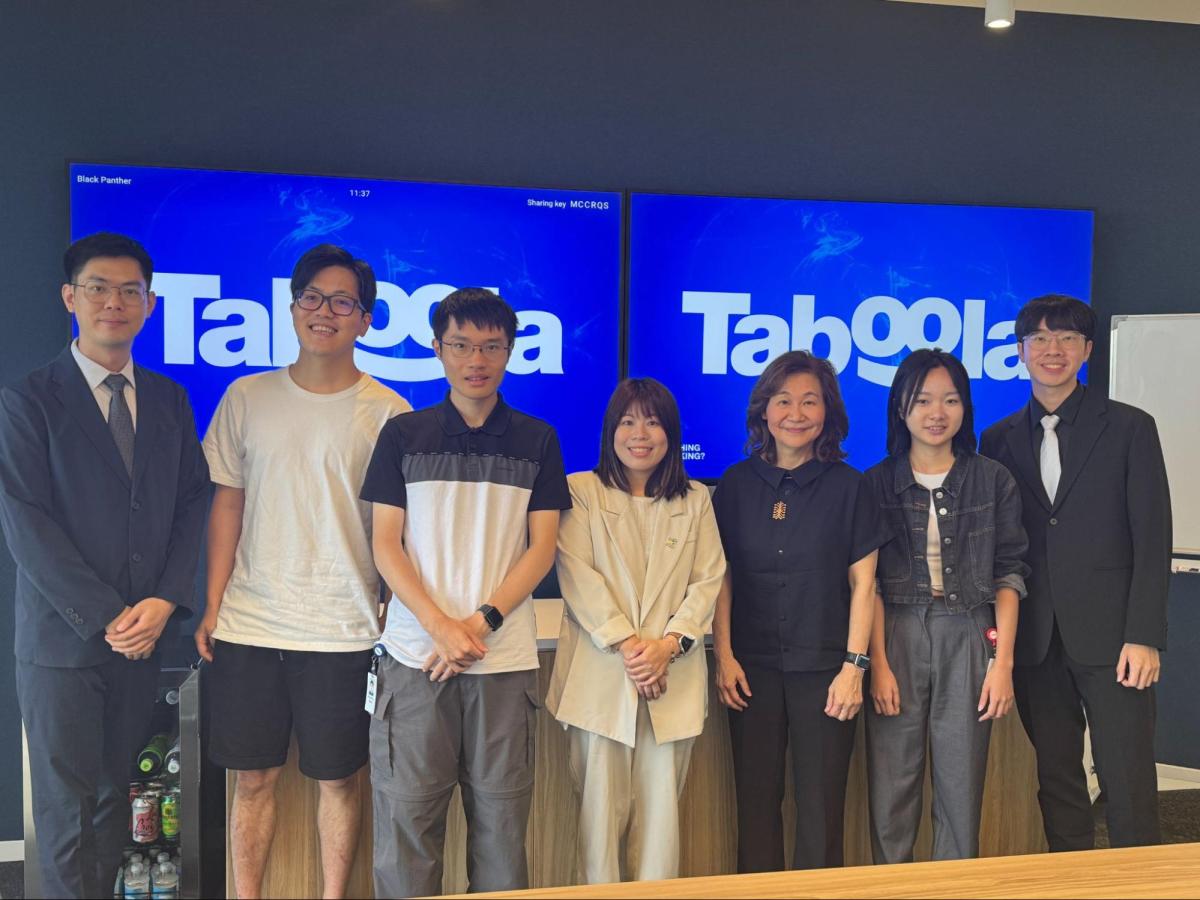
Taboola is a global digital advertising technology company that uses AI, data and recommendation technology to connect publishers, advertisers and audiences. For most people, these systems operate quietly behind the websites and digital content they use every day. Behind the scenes, however, they rely on large-scale data, AI models, software systems and close collaboration across product and engineering teams.
Through Taipei’s 2025 Youth Overseas Internship Program, Cheng-Peng and Ivana joined Taboola’s Los Angeles team, working on software development and AI Data Science projects. Their experience went far beyond exposure to new technologies. They took part in the development process inside a global technology company—from understanding user needs and designing systems to testing models and bringing solutions into production.
When Technology Has to Work for Its Users
For Cheng-Peng, one of the most meaningful parts of the internship was building an internal AI tool from the ground up.
The tool was designed for Taboola’s Sales Team and Account Managers. Its purpose was straightforward: help users search internal information, access backend data, and turn that information into reports or presentations without having to manually search across different sources.
Cheng-Peng worked mainly on backend design, development and data integration. Yet the biggest difference between this project and the technical work he had done before was not the code itself.
The people using the tool were not engineers.
That meant he had to ask a different set of questions: How do users currently find the information they need? Which steps take the most time? Does a feature that seems intuitive to an engineer make sense to someone in sales?
Through repeated conversations with non-technical colleagues, Cheng-Peng began to understand that building a product is not only about whether something can be built. It is also about why it should be built, and whether it actually helps the people using it.
Good technology is not only about whether it works. It is about whether people can actually use it to solve a problem.
That shift—from writing code to thinking about users—was one of the clearest ways the experience moved beyond classroom assignments or personal projects.
From Model Testing to Production
Ivana encountered a different side of applied AI.
As part of Taboola’s Data Science team, she worked on a project involving large language models. The team was exploring whether a smaller in-house model could replace a larger one used in advertising-content review, while reducing computing and external API costs without compromising performance.
At first, the task might sound simple: find a smaller model that performs just as well.
In practice, the challenge was much more complex.
Accuracy mattered, but so did consistency, processing speed, system capacity and cost. Early tests showed a noticeable gap between the smaller models and the existing baseline, so Ivana tested different approaches, reviewed the results with her mentor, and kept refining the solution.
Eventually, the work moved beyond experimentation. The solution she contributed to was integrated into the codebase and deployed into production, where the team could continue monitoring performance, traffic, latency and cost.
For Ivana, the experience offered a clear view of how an AI model moves from testing into production.
Once AI moves into production, the question is no longer only whether it performs well. It has to be reliable, efficient and useful at scale.
The experience gave practical meaning to concepts that can otherwise feel abstract—model evaluation, system performance and cost trade-offs.
Learning How Technology Is Built as a Team
Both participants also came away with a stronger understanding of how technology is built collaboratively.
Taboola’s engineering teams worked in structured development cycles, using project-management systems, short daily meetings, code review and version control to keep work moving and ensure that individual contributions could be safely integrated into larger products.
For Ivana, that made the difference between “code that runs” and “code a team can continue to use” much more tangible. She could regularly discuss problems with mentors and teammates, review existing code, and receive feedback not only on whether something worked, but on whether the logic was clear and maintainable.
Cheng-Peng experienced collaboration from another angle. Because his AI tool connected engineering with sales and account management, he had to move constantly between technical possibilities and user needs.
Different projects, but the same lesson: Technical skills matter most when they can be translated into something a team can build on together.
When an International Tech Career Becomes Tangible
The internship gave both participants firsthand experience of what an international career in technology could look like.
Cheng-Peng had already considered studying and working in the United States. But living there, joining a team and experiencing the workplace firsthand gave him something that online research or second-hand impressions could not: a much clearer basis for deciding what kind of environment he wants for his future.
Ivana had a similar experience. Outside the office, she handled housing, banking and everyday life on her own, while also exploring Los Angeles and the surrounding region. What had once felt distant—living and working abroad—became something concrete and manageable.
More importantly, both now knew what happened when their existing skills were placed inside an international technology company.
Cheng-Peng’s system had to meet user needs. Ivana’s model had to meet the demands of a production environment.
That is what made the experience different from simply adding “AI,” “software development” or “Data Science” to a résumé.
For Taboola, Cheng-Peng and Ivana were not simply there to observe how a global technology company operates. One contributed to the development and deployment of an internal AI tool; the other worked on model evaluation, optimization and production integration. Both entered the team with a technical foundation and used hands-on projects to push those skills further.
That is also an important part of what Taipei’s Youth Overseas Internship Program is designed to create.
Young people are not sent abroad to start from zero. They bring abilities they have already built, then test them against user needs, cross-functional teamwork and industry standards. Host organizations, in turn, gain access to young talent with strong technical foundations, fresh perspectives and the ability to contribute directly to ongoing work.
For Taipei, each of these experiences creates another point of connection between local talent and global industries.
Cheng-Peng and Ivana did not come back as completely different people.
But one thing had changed.
What once felt like a future they hoped to enter had become a place where they had already contributed.
The world was no longer somewhere they hoped to join one day. It had become a place where they already knew they could belong.